Blog
Calcium Hypochlorite Manufacturing Process
Calcium hypochlorite [Ca(ClO)₂] is one of the most widely produced chlorine-based disinfectants in the world, with global production exceeding 500,000 metric tons annually. Its manufacturing involves controlled chemical reactions between chlorine gas and calcium compounds. Understanding the production process is essential for procurement managers, quality assurance teams, and water treatment engineers who need to evaluate supplier capabilities and product quality.
As a manufacturer of calcium hypochlorite granular and calcium hypochlorite tablets, Everglory Industrial provides this technical overview of the two primary production methods, quality control parameters, and industry specifications.
The Two Production Methods
There are two industrial methods for producing calcium hypochlorite:
| Parameter | Calcium Process | Sodium Process |
|---|---|---|
| Primary Feedstock | Calcium hydroxide (slaked lime) | Sodium hydroxide + calcium hydroxide |
| Chlorine Source | Chlorine gas (Cl₂) | Chlorine gas (Cl₂) |
| Byproduct | Calcium chloride | Sodium chloride (salt) |
| Available Chlorine | 60-70% | 70-75% |
| Product Purity | Lower (more impurities) | Higher (more refined) |
| Global Market Share | ~30% | ~70% |
| Preferred For | Cost-sensitive markets | High-grade applications |
Sodium Process: Step-by-Step (Primary Method)
The sodium process is the dominant production method worldwide because it produces higher-purity calcium hypochlorite with 70-75% available chlorine. Here are the key steps:
Step 1: Chlorine-Alkali Reaction
Chlorine gas (Cl₂) is passed through a sodium hydroxide (NaOH) solution to produce sodium hypochlorite (NaClO):
2NaOH + Cl₂ → NaClO + NaCl + H₂O
This reaction takes place in a cooled reactor at 15-25°C to prevent decomposition. The resulting sodium hypochlorite solution typically has 10-15% available chlorine concentration.
Step 2: Calcium Hypochlorite Precipitation
The sodium hypochlorite solution is then mixed with a calcium hydroxide [Ca(OH)₂] slurry in a precipitation reactor. This reaction forms calcium hypochlorite as a solid precipitate:
2NaClO + Ca(OH)₂ → Ca(ClO)₂ + 2NaOH
The reaction is carefully controlled at 30-40°C with continuous stirring. The calcium hypochlorite forms as a crystalline solid suspended in the solution, while sodium hydroxide is regenerated and recycled back to Step 1.
Step 3: Filtration and Washing
The calcium hypochlorite crystals are separated from the mother liquor using centrifugal filters or vacuum filters. The filter cake is then washed with chilled water to remove residual sodium chloride, sodium hydroxide, and other impurities. The washing process is critical — insufficient washing leaves salt and alkali residues that reduce product stability.
Step 4: Drying
The wet calcium hypochlorite cake (containing 30-40% moisture) is dried in a rotary dryer or fluidized bed dryer at controlled temperatures (60-80°C). Temperature control is critical — temperatures above 100°C can cause thermal decomposition and create a fire hazard. The dried product should have moisture content below 5-7%.
⚠️ Manufacturing Safety
Calcium hypochlorite drying is the most hazardous step in production. The wet product is relatively stable, but as it dries, it becomes increasingly reactive. Modern facilities use nitrogen-inerted drying systems and strict temperature monitoring to prevent decomposition events. All equipment must be spark-proof and regularly cleaned to prevent contamination buildup.
Step 5: Granulation and Sizing
The dried calcium hypochlorite is processed through granulation equipment to achieve the desired particle size distribution. Common specifications:
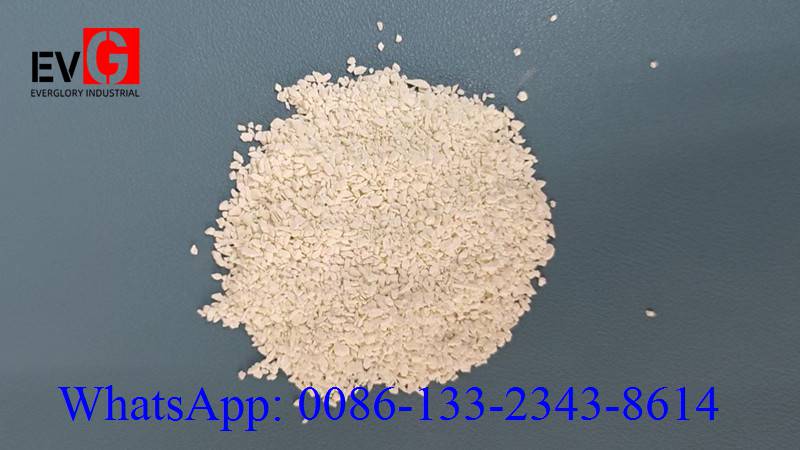
- Granular: 8-30 mesh (0.6-2.4mm) — for pool shock and water treatment
- Tablet grade: 20-60 mesh (0.25-0.85mm) — fine powder for tablet compression
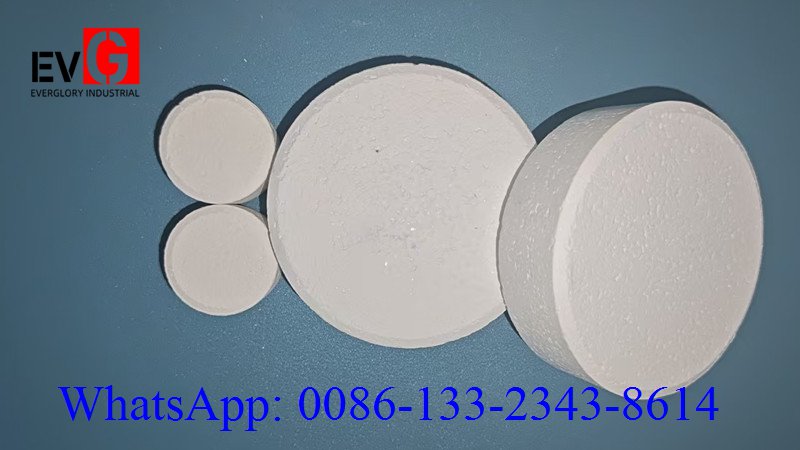
- Briquette grade: Custom sizes for specific dosing applications
Step 6: Packaging
Finished calcium hypochlorite is packaged in moisture-proof HDPE drums (typically 40kg or 45kg) with inner PE bags. Each drum is sealed, labeled with UN 2880 classification, and tested for moisture content before shipping. Proper packaging is essential — moisture ingress during storage can accelerate decomposition and create safety risks.
Calcium Process (Alternative Method)
The calcium process is simpler and less expensive but produces a lower-grade product. In this method, chlorine gas is directly passed through a calcium hydroxide slurry:
2Ca(OH)₂ + 2Cl₂ → Ca(ClO)₂ + CaCl₂ + 2H₂O
The resulting product is a mixture of calcium hypochlorite and calcium chloride, typically yielding 60-70% available chlorine. The calcium chloride byproduct is difficult to separate completely, which is why this method produces a less pure product. However, it requires fewer processing steps and lower capital investment, making it popular in developing markets.
Quality Control Parameters
| Parameter | Premium Grade | Standard Grade | Test Method |
|---|---|---|---|
| Available Chlorine | ≥70% | ≥65% | Iodometric titration |
| Moisture Content | ≤5% | ≤7% | Karl Fischer / oven drying |
| Particle Size | Per spec | Per spec | Sieve analysis |
| Water Insolubles | ≤5% | ≤10% | Filtration / gravimetric |
| Stability (72hr @ 80°C) | ≥90% retention | ≥85% retention | Accelerated aging test |
| Heavy Metals (as Pb) | ≤10 ppm | ≤20 ppm | ICP-MS |
| Iron Content | ≤100 ppm | ≤200 ppm | AAS / ICP |
Industry Standards and Certifications
Quality calcium hypochlorite should meet one or more of these standards:
- NSF/ANSI Standard 60 — Drinking water treatment certification (US)
- EN 12931 — European standard for calcium hypochlorite used in swimming pools
- WHO Guidelines — For drinking water quality (4th Edition)
- GB/T 10666-2008 — Chinese national standard for calcium hypochlorite
- REACH Registration — Required for EU market access
Request these certifications from your supplier and verify them with third-party test reports (SGS, Intertek, or Bureau Veritas) before bulk purchasing.
Frequently Asked Questions
What is the difference between calcium process and sodium process calcium hypochlorite?
The sodium process uses sodium hydroxide as an intermediate, producing higher-purity calcium hypochlorite with 70-75% available chlorine. The calcium process directly chlorinates calcium hydroxide, producing a less pure product (60-70% available chlorine) with calcium chloride as a byproduct. The sodium process accounts for ~70% of global production due to its superior quality.
What raw materials are used to make calcium hypochlorite?
The primary raw materials are chlorine gas (Cl₂), sodium hydroxide (NaOH, for the sodium process), and calcium hydroxide (Ca(OH)₂, also known as slaked lime). Chlorine gas is typically produced on-site via chlor-alkali electrolysis of brine (salt water), which also co-produces sodium hydroxide and hydrogen gas.
Is calcium hypochlorite production dangerous?
Yes, production involves significant hazards: toxic chlorine gas, exothermic reactions, and a reactive final product. Modern facilities mitigate these risks with closed-loop systems, chlorine gas detection and scrubbing, temperature-controlled reactors, nitrogen-inerted drying, and strict safety protocols. Workers require specialized training and PPE including self-contained breathing apparatus for certain operations.
How is calcium hypochlorite quality tested?
Key quality tests include: iodometric titration for available chlorine content, Karl Fischer titration for moisture, sieve analysis for particle size, accelerated aging (72 hours at 80°C) for thermal stability, and ICP-MS for heavy metals. Reputable manufacturers test every batch and provide certificates of analysis (COA) with each shipment.
What is the CAS number and UN number for calcium hypochlorite?
The CAS number is 7778-54-3. The UN number for shipping is UN 2880, classified as Class 5.1 (Oxidizing Substance), Packing Group II. This classification applies to calcium hypochlorite with more than 39% available chlorine (6.8% active oxygen), which covers all commercial grades (65-75% available chlorine).