Blog
Pool Chlorine Dosage Chart: Complete Guide for All Pool Sizes
Getting the right chlorine dosage is the single most important skill in pool maintenance. Too little chlorine leaves your pool vulnerable to bacteria and algae; too much can damage equipment, irritate swimmers, and waste money. This comprehensive dosage chart covers calcium hypochlorite, TCCA (trichlor), and dichlor (SDIC) — the three most common chlorine types used in pool maintenance — across all pool sizes and treatment scenarios.
As a manufacturer of calcium hypochlorite granular and chlorine tablets, Everglory Industrial has compiled these dosage tables from industry standards, WHO guidelines, and our technical team's 15+ years of water treatment experience. Bookmark this page for quick reference.
How to Use This Chart
Step 1: Determine your pool volume (use the formula below if unsure).
Step 2: Identify your chlorine type (cal hypo 70%, TCCA 90%, or dichlor 60%).
Step 3: Choose your treatment goal (maintenance, shock, or algae treatment).
Step 4: Find your dosage in the corresponding table below.
Pool Volume Calculator
If you don't know your pool volume, calculate it using these formulas:
| Pool Shape | Formula (US) | Formula (Metric) |
|---|---|---|
| Rectangular | Length × Width × Avg Depth × 7.5 = Gallons | Length × Width × Avg Depth × 1000 = Liters |
| Circular | Radius² × Depth × 5.9 = Gallons | Radius² × Depth × 3.14 × 1000 = Liters |
| Oval | Length × Width × Avg Depth × 6.7 = Gallons | Length × Width × Avg Depth × 0.89 × 1000 = Liters |
Example: A rectangular pool 20ft × 40ft with 5ft average depth = 20 × 40 × 5 × 7.5 = 30,000 gallons (113,550 L)
Dosage Chart 1: Calcium Hypochlorite (70% Available Chlorine)
Calcium hypochlorite is the standard pool shock chemical. It dissolves fast, delivers immediate chlorine, and doesn't add cyanuric acid. Use for shock treatment and rapid chlorine correction.
| Pool Volume | Maintenance (1-3 ppm increase) |
Shock Treatment (5-7 ppm increase) |
Algae Treatment (10 ppm increase) |
|---|---|---|---|
| 5,000 gal / 19,000 L | 2 oz / 55g | 8 oz / 225g | 1 lb / 450g |
| 10,000 gal / 38,000 L | 4 oz / 110g | 1 lb / 450g | 2 lb / 900g |
| 15,000 gal / 57,000 L | 6 oz / 170g | 1.5 lb / 675g | 3 lb / 1,350g |
| 20,000 gal / 76,000 L | 8 oz / 225g | 2 lb / 900g | 4 lb / 1,800g |
| 25,000 gal / 95,000 L | 10 oz / 280g | 2.5 lb / 1,130g | 5 lb / 2,270g |
| 30,000 gal / 114,000 L | 12 oz / 340g | 3 lb / 1,350g | 6 lb / 2,720g |
| 40,000 gal / 151,000 L | 1 lb / 450g | 4 lb / 1,800g | 8 lb / 3,630g |
| 50,000 gal / 189,000 L | 1.25 lb / 565g | 5 lb / 2,270g | 10 lb / 4,540g |
Note: Cal hypo 70% dosages are based on raising free chlorine by the indicated ppm. Actual dosage may vary ±15% depending on water temperature, pH, cyanuric acid level, and organic load. Always test water 30 minutes after adding chemicals and adjust as needed.
Dosage Chart 2: TCCA 90% (Trichlor Tablets & Granules)
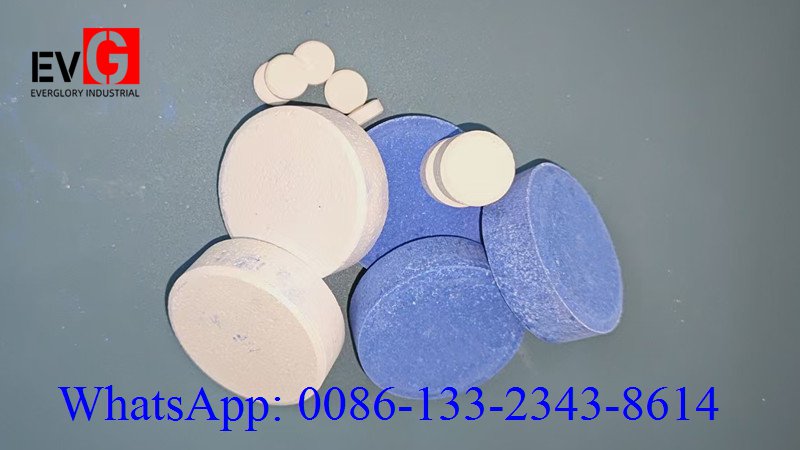
TCCA is used primarily for daily maintenance via slow-dissolving tablets. It has 90% available chlorine and contains cyanuric acid for UV protection. Ideal for outdoor pool maintenance.
| Pool Volume | Daily Maintenance (maintain 1-3 ppm) |
Tablet Usage (3-inch / 200g tablets) |
Granular TCCA (5 ppm increase) |
|---|---|---|---|
| 5,000 gal / 19,000 L | 0.5 oz / 14g | 1 tablet / 5-7 days | 3 oz / 85g |
| 10,000 gal / 38,000 L | 1 oz / 28g | 1-2 tablets / 5-7 days | 6 oz / 170g |
| 15,000 gal / 57,000 L | 1.5 oz / 42g | 2 tablets / 5-7 days | 9 oz / 255g |
| 20,000 gal / 76,000 L | 2 oz / 55g | 2-3 tablets / 5-7 days | 12 oz / 340g |
| 30,000 gal / 114,000 L | 3 oz / 85g | 3-4 tablets / 5-7 days | 1.5 lb / 680g |
| 40,000 gal / 151,000 L | 4 oz / 110g | 4-5 tablets / 5-7 days | 2 lb / 900g |
| 50,000 gal / 189,000 L | 5 oz / 140g | 5-6 tablets / 5-7 days | 2.5 lb / 1,130g |
Dosage Chart 3: Dichlor (SDIC 60% Available Chlorine)
Sodium dichloroisocyanurate (SDIC) is a fast-dissolving, pH-neutral chlorine with 60% available chlorine. It contains cyanuric acid but dissolves faster than TCCA, making it ideal for spas, hot tubs, and quick pool adjustments.
| Pool/Spa Volume | Maintenance (2 ppm increase) |
Shock (5 ppm increase) |
Super Shock (10 ppm increase) |
|---|---|---|---|
| 500 gal / 1,900 L (Spa) | 0.25 oz / 7g | 0.6 oz / 17g | 1.3 oz / 37g |
| 1,000 gal / 3,800 L | 0.5 oz / 14g | 1.3 oz / 37g | 2.5 oz / 71g |
| 5,000 gal / 19,000 L | 2.5 oz / 71g | 6 oz / 170g | 12.5 oz / 355g |
| 10,000 gal / 38,000 L | 5 oz / 142g | 12.5 oz / 355g | 1.5 lb / 680g |
| 20,000 gal / 76,000 L | 10 oz / 284g | 1.5 lb / 680g | 3 lb / 1,360g |
| 30,000 gal / 114,000 L | 15 oz / 425g | 2.3 lb / 1,045g | 4.5 lb / 2,040g |
Cyanuric Acid (CYA) Adjustment Factor
If your pool has cyanuric acid (from TCCA or dichlor use), you need more chlorine to achieve the same sanitizing effect. Use this multiplier:
| CYA Level | Target Free Chlorine | Dosage Multiplier |
|---|---|---|
| 0 ppm (no CYA) | 1–3 ppm | 1.0× (use chart as-is) |
| 20–30 ppm | 2–4 ppm | 1.2× (add 20%) |
| 30–50 ppm (ideal outdoor) | 3–5 ppm | 1.5× (add 50%) |
| 50–80 ppm | 5–8 ppm | 2.0× (double the dose) |
| 80–100 ppm (high) | 8–12 ppm | 2.5× (partial drain recommended) |
| 100+ ppm (too high) | Not effective | Drain 30-50% of pool water |
⚠️ Safety Rules
1. Never mix different chlorine types in concentrated form — dangerous chemical reactions can occur.
2. Always add chlorine to water, never water to chlorine.
3. Pre-dissolve granular chlorine for vinyl-lined pools.
4. Run the pump for at least 1 hour after dosing before swimming.
5. Store all chlorine products in a cool, dry place away from acids and organic materials.
Frequently Asked Questions
How much chlorine do I need for a 10,000 gallon pool?
For a 10,000 gallon pool: maintenance dose is 4 oz of cal hypo 70%, 1 oz of TCCA 90%, or 5 oz of dichlor 60%. For shock treatment, use 1 lb of cal hypo, 6 oz of TCCA granular, or 12.5 oz of dichlor. Always test water 30 minutes after adding chemicals and adjust if needed.
How do I calculate pool chlorine dosage?
Calculate pool volume first (Length × Width × Average Depth × 7.5 for rectangular pools in gallons). Then determine your desired chlorine increase in ppm. The general formula is: (Pool Volume in gallons × Desired ppm increase × 0.013) ÷ (Available Chlorine %) = ounces of product needed. Use our dosage charts above for quick reference without manual calculation.
What happens if I add too much chlorine to my pool?
Chlorine levels above 5 ppm can cause skin and eye irritation, fade swimwear, damage pool liners and equipment, and create harmful chloramine byproducts. If chlorine exceeds 5 ppm, wait 12-24 hours for levels to naturally decrease, use a chlorine neutralizer (sodium thiosulfate) at 2 oz per 10,000 gallons to reduce by 5 ppm, or partially drain and refill the pool.
Can I use the same chlorine dosage for an indoor pool?
No. Indoor pools require lower chlorine levels (1-3 ppm) because there's no UV degradation. Additionally, you should avoid chlorine products that contain cyanuric acid (TCCA, dichlor) for indoor pools, as CYA provides no benefit indoors and can accumulate to problematic levels. Use calcium hypochlorite for indoor pool maintenance and shocking.
How often should I shock my pool?
Shock your pool every 7-10 days during swimming season, or every 5 days in hot weather. Also shock after heavy use, rainstorms, or when combined chlorine (chloramines) exceeds 0.2 ppm. Use 1 lb of calcium hypochlorite per 10,000 gallons for standard shock, or double that amount for algae treatment.